
rong>Steel entry doors are the most common front and back doors in Toronto homes, and for good reason. They’re strong, secure, well insulated and cost less than fibreglass or solid wood. But steel has its own weak spots: it dents, it rusts from the bottom up once salt and water get in, and it’s heavy enough to pull its hinges out of a tired frame. The good news is that most steel door problems can be repaired without replacing the whole door. Here’s what goes wrong with steel entry doors in Toronto and the GTA, what’s fixable, and when replacement makes more sense. Need help now? Call 866-820-1331. A typical steel entry door isn’t solid steel. It’s two thin steel skins, usually 24 or 26 gauge, wrapped around a wood or composite frame and filled with foam insulation. The edges where the lock and hinges mount are wood or composite. The bottom rail sits right above the sill, where water, snow and salt collect all winter. That construction explains almost every problem below: Steel doors in the GTA deal with a tougher mix than most places. Winters bring road salt tracked onto porches, snow piled against the door and freeze-thaw cycles that move frames and sills. Summers bring strong sun on south- and west-facing entries and humid air that finds its way into any gap in the paint. Older homes add their own twist: frames that have settled over decades, sills that slope the wrong way, and porches with no overhang to keep rain off the door. In older neighbourhoods we often see steel doors installed into original wood frames that were never meant for a heavy foam-core slab. In newer subdivisions the common issue is builder-grade doors with thin skins and short screws. Both can be made solid with the right fixes, but they fail in different ways, so the first visit always starts with a look at the frame, not just the door. Dents come from kicks, furniture, hockey pucks, ladders and attempted break-ins. A small dent is cosmetic. A dent near the lock edge or a crease across the door is a different story, because it can stop the door from sealing or latching. Small, shallow dents can be filled with a metal-safe body filler, sanded flat and repainted so they almost disappear. Deep creases, dents that have torn the skin, or damage along the edge usually can’t be made perfect. In those cases the question is whether you can live with the look, or whether it’s time for a new slab. Don’t try to pull dents out with a suction cup or a screw. The skin is too thin, and you’ll end up with a bigger, uneven bulge. This is the classic Toronto steel door problem. Salt, slush and melt water sit on the sill all winter. Once the paint chips at the bottom corner, rust starts and spreads under the paint. You’ll see bubbling paint first, then orange flakes, then holes. If the rust is on the surface, we sand it back to clean steel, treat it, prime it with a rust-inhibiting primer and repaint. Replacing the door sweep and adding a kick plate keeps it from coming back. When rust has eaten holes through the skin, the wood frame inside is often wet or rotted too. Patching the outside hides it for a season. At that point a new slab, or a full door replacement, is usually the honest answer. Steel doors usually sit in wood frames. If the door bottom rusted, the bottom of the jamb and the brick mould may be rotted as well. See exterior door frame repair in Toronto. Steel doors rely on magnetic or compression weatherstripping. When the door is warped, sagging or dented near the edge, it stops touching the seal evenly. You feel cold air, see light around the edges, or get frost on the inside in January. We reset the hinges and strike so the door sits evenly, then replace the weatherstripping and sweep. If the door is warped, adjustment can often bring the seal back, but a badly bowed slab won’t seal no matter what. Our post on winter door problems in Toronto covers the cold-weather side of this. A foam-filled steel door with a glass insert is heavy. Over the years the top hinge screws loosen or strip, and the door drops on the latch side. It starts rubbing the frame at the top corner or dragging on the sill. Tighten the hinge screws. If the top hinge screws spin, they’ve stripped the wood. The fix is longer screws that reach the house framing, not just the jamb. If the jamb is split around the hinge, or tightening doesn’t help, the hinges need resetting or replacing. See door hinge repair in Toronto. If the door won’t close at all, read our guide on why a door won’t close properly. When a steel door sags or the frame moves, the deadbolt starts dragging on the strike, and the key gets hard to turn. People blame the lock, but the lock is usually fine. We fix the alignment first, then adjust the strike. If the lock itself is worn, we replace or rekey it. Our front door won’t lock guide goes deeper, and you can see our lock change service in Toronto for upgrades. Steel doors are tough, but the weak point is the frame. Kick-ins usually split the wood jamb at the strike, and pry attacks bend the skin at the lock edge. The door may still close but won’t lock securely. We secure the door the same day, repair or replace the split jamb, and add a reinforced strike plate with long screws into the framing. If the skin is torn at the lock, a new slab is usually the safe choice. See 24-hour burglary repairs in Toronto. South- and west-facing steel doors in Toronto take a lot of sun. Paint fades, chalks and peels, and once it peels at the bottom, rust follows. Repainting with a proper exterior primer and paint made for metal is one of the best things you can do for an older steel door. Very dark colours on steel doors in full sun can cause the skin to heat up and bow. If your door faces the afternoon sun, a mid-tone colour is kinder to it. Many steel entry doors have a decorative glass insert or a half-lite. The insert is held in by a plastic or composite frame screwed through the door. Over time the sealant between the frame and the steel dries out, and water gets inside the door, which is a common hidden cause of rust and swelling at the bottom. Leaking inserts can be removed, resealed and reinstalled. Fogged sealed glass can often be replaced with a matching insert, as long as the door itself is still sound. Back and side steel doors to garages, yards and basement walkouts often get less attention than the front door, but they usually face more weather and get used harder. We often find them with rusted bottoms, broken closers on storm doors, loose hinges and weak locks, which makes them the easiest way into a house. If the answer to any of these is no, it’s worth fixing before winter. See doors and locks in Toronto. Steel door skins are measured by gauge. A lower number means thicker steel. Builder-grade doors often use 26 gauge, which dents easily. Better residential doors use 24 gauge, and commercial hollow metal doors are much heavier, typically 18 to 16 gauge. If your door dents every time something bumps it, a heavier gauge slab is worth considering when you replace it. The gauge is sometimes printed on a label on the hinge edge of the door. If not, knock on the door: a thin skin sounds hollow and “tinny”, while a heavier skin sounds solid. Any of these get worse each winter. Catching them early is almost always cheaper than replacing the door and frame later. If replacement is on the table, our guide to choosing a new front door in Toronto compares steel, fibreglass and wood. You can also see recommended door replacements and front door upgrades in Toronto. For most Toronto homes, yes. Steel gives excellent security and insulation for the price. Its main weakness is denting and rust. Fibreglass doesn’t dent or rust and holds up better on exposed doors, but it costs more. If your old steel door rusted out because water sits on the sill, fix the drainage and sill at the same time, whatever material you choose next. We also repair commercial steel and hollow metal doors on shops, warehouses and multi-unit buildings: closers, panic hardware, hinges and frames. See commercial door repair in Toronto and commercial doors repairs. Steel entry door repair across Toronto and the GTA, including Toronto front door repair, Markham, Vaughan, Richmond Hill, Brampton, Mississauga and Oakville. Need locks changed while we’re there? We cover Scarborough, Vaughan, Richmond Hill, Mississauga, Brampton and Oakville. Small, shallow dents can be filled, sanded and repainted so they’re barely visible. Deep creases or dents at the edge of the door usually mean a new slab is the better option. Surface rust is very repairable. If the rust has made holes through the skin, the inside of the door is usually damaged too, and replacement makes more sense. Worn weatherstripping, a worn sweep, sagging hinges or a warped slab. We align the door first, then replace the seals so they actually touch. Most often the door has sagged and the deadbolt is dragging on the strike. Fixing the alignment usually fixes the key. Either. If the frame is in good shape, a new slab can be fitted. If the frame and sill are damaged, a complete pre-hung door is usually better. Dented, rusting, drafty or hard to lock? Call Door Repair Toronto at 866-820-1331 or contact us. We’ll tell you straight whether it’s a repair or a replacement.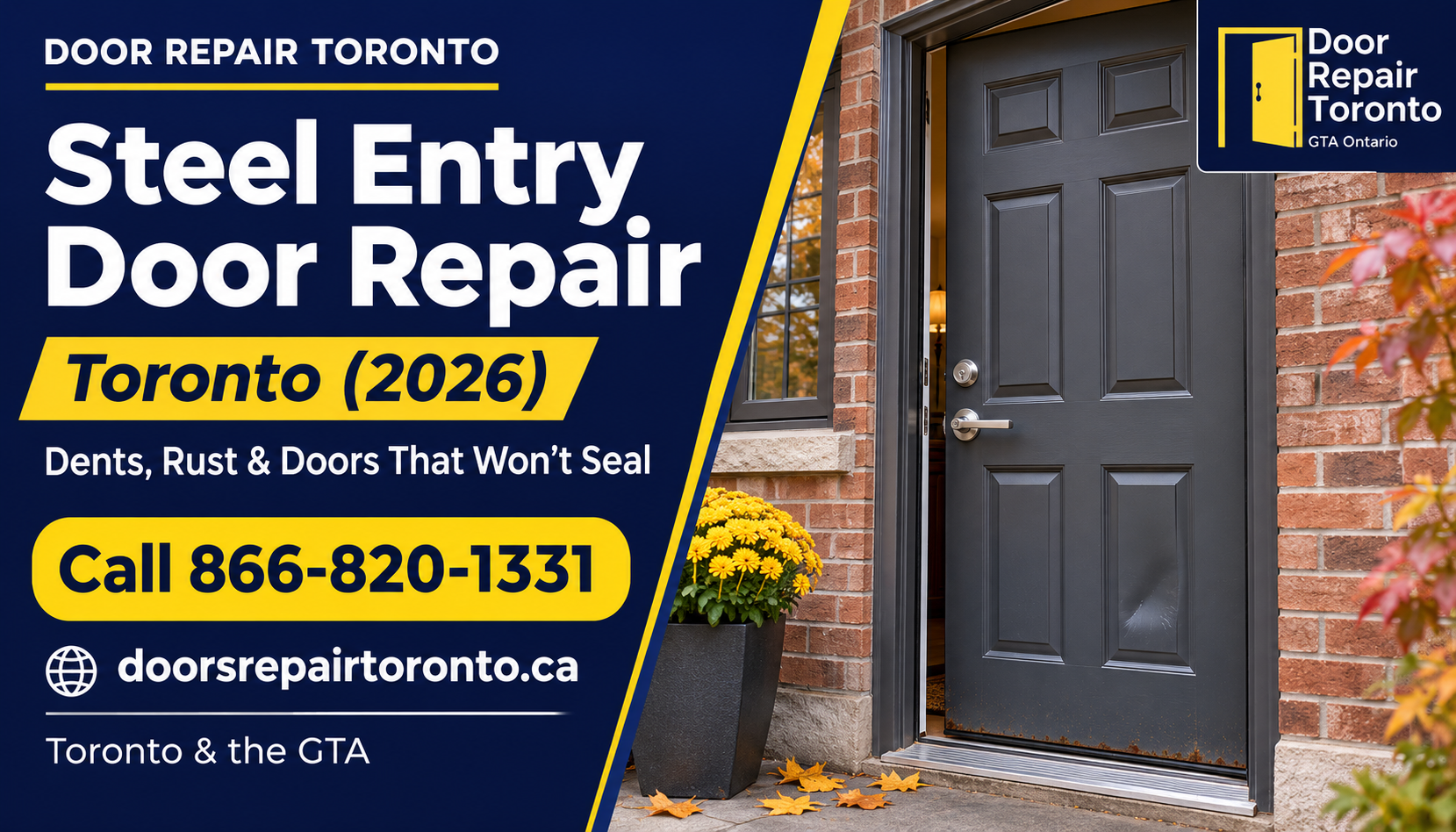
How a residential steel entry door is built
Why Toronto is hard on steel doors
Older homes vs. newer builds

Problem 1: Dents in the steel skin
Can a dented steel door be repaired?
What not to do
Problem 2: Rust at the bottom of the door
Early rust: repairable
Rust-through: usually not worth patching
Check the frame too
Problem 3: The door won’t seal, so you get drafts
Usual causes
The fix

Problem 4: The door sags or rubs
What you can check
When to call
Problem 5: The lock or deadbolt won’t line up
Fixing it properly
Problem 6: Damage after a break-in
What we do
Problem 7: Peeling paint and fading
A tip on colour

Problem 8: Glass inserts that leak or fog
Signs to watch for
What we do
Back doors and side doors take the most abuse
Quick security check for back doors
Steel door skin gauge: why it matters
Checking your door
Signs your steel door needs attention now
Steel door repair or replacement? How to decide
Repair usually makes sense when:
Replacement usually makes sense when:
Steel door vs. fibreglass: is steel still a good choice?
How to make a steel entry door last longer
Every season
Every year
Small upgrades that help a lot
What’s included in a steel door repair visit
Steel door repair for businesses too
Areas we serve
Steel entry door repair FAQ
Can you fix a dent in a steel door?
Is a rusted steel door worth repairing?
Why is my steel door letting in cold air?
Why is my key hard to turn on my steel front door?
Do you replace just the steel slab or the whole door?
Get your steel door fixed